![Laudio_Wordmark_RGB_Color (1)-3.png]](https://7157272.fs1.hubspotusercontent-na1.net/hubfs/7157272/Laudio_Wordmark_RGB_Color%20(1)-3.png)
The Speedometer in Laudio gives leaders a clear view of their engagement activity with team members in their downline over the past 90 days. It is designed to support goals related to strengthening team member engagement, improving retention, and reducing burnout.
Key Benefits
- Visual summary of engagement activity over the past 90 days
- Helps leaders stay proactive with team member interactions
- Encourages consistent, meaningful engagement
Where to Find the Speedometer
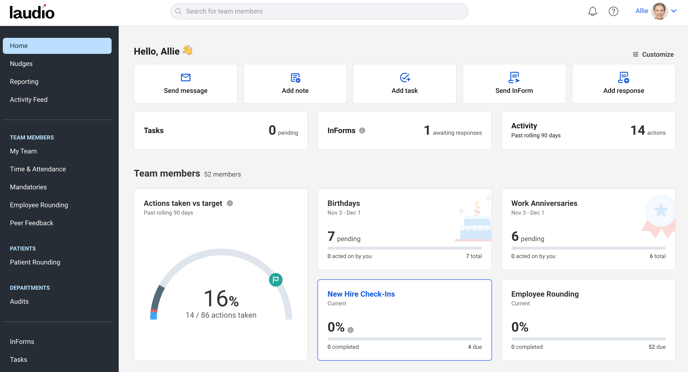
Using the Speedometer
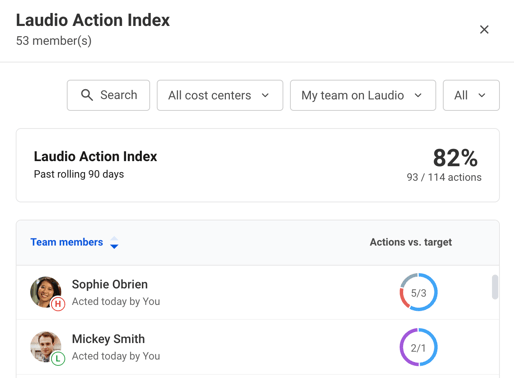
When the speedometer widget is clicked from the Home page, it displays a list of all team members within your downline. You can filter this list by direct reports, cost centers, or status.
Each team member displayed in the slide out contributes to the total recommended actions that Laudio suggests based on that team member's individual turnover risk score.
Action targets are tied to turnover risk (and adjusted by FTE when applicable):
- High Risk: Laudio recommends 3 actions every 90 days
- Medium Risk: Laudio recommends 2 actions every 90 days
- Low Risk: Laudio recommends 1 action every 90 days
The combined turnover risk scores of all listed team members are combined to form the denominator that determines the total number of recommended actions.
Which Activities Count Towards the Speedometer
The speedometer score is a team member centric metric. It counts activities that strengthen engagement across your team and contribute toward the overall target. Actions that count toward the speedometer include:
- Sending an email
- Add a note to a team member's profile
- Completing a nudge or recommendation
All actions contribute to progress, even those that exceed the 75% target. Any activity completed in Laudio by any leader can count toward the speedometer. It serves as a measure of how all team members are being engaged with across the platform.
FAQs
Q: How does Laudio calculate the action target number for each team member
A: Targets are based on turnover risk and scaled by the FTE for the cost center.
Laudio recommends
- High Turnover Risk 3 actions every 90 days
- Medium Turnover Risk 2 actions every 90 days
- Low Turnover Risk 1 action every 90 days
A leader’s overall target is the sum of all individual team member targets.
Q: Why is my total number of actions higher than my target number
A: The total includes every message sent, note added, and recommendation completed in Laudio. Leaders can always exceed their recommended actions. This means the total number of actions is greater than the target.
Q: If my total actions are higher than my target, why is my Speedometer score not above 100 percent
A: The Speedometer currently caps at 100 percent.
Q: How is the Turnover Risk Score calculated
A: Laudio uses a proprietary model that evaluates behavior and work pattern data across health systems nationally to predict turnover risk. The model analyzes:
- Demographic information
- Behavior trends
- Organizational data
- Burnout indicators
The score updates over time as trends change across a dataset of nearly five hundred thousand frontline staff.
Q: Is the Turnover Risk Score tailored to different roles and departments
A: Yes. Different roles show different engagement patterns, so the model accounts for these differences. Leaders also bring important personal context that complements the score.
Q: What if a team member receives a high risk score that seems inaccurate?
A: A team member's turnover risk is not to replace what leaders know about their team members. The score helps prioritize engagement based on operational data from a model trained on more than three hundred thousand team members across the US.
Q: How meaningful is the turnover risk score for salaried team members?
A: The same methodology is used for salaried employees, except the model excludes time clock data. The data used to measure turnover risk for salaried team members relies more heavily on demographic data, such as one's tenure.