![Laudio_Wordmark_RGB_Color (1)-3.png]](https://support.laudio.com/hs-fs/hubfs/Laudio_Wordmark_RGB_Color%20(1)-3.png?height=41&name=Laudio_Wordmark_RGB_Color%20(1)-3.png)
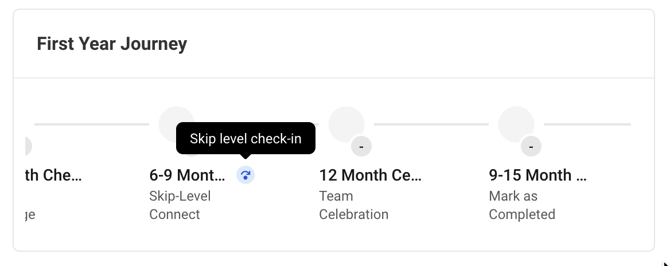
Skip-Level Check-ins help extend the New Hire Check-ins (NHC) experience beyond the traditional 30, 60, and 90-day milestones. A Skip-Level Check-in gives senior leaders opportunities to engage with new hires at key points throughout their first year. Skip-Level Check-ins are limited to the team member and the direct manager’s manager. They do not include the full management chain.
Key Benefits
💙 Tip: Use Skip-Level Check-ins to create meaningful leader-of-leader connections during the first year. Combine standard check-ins, InForms, Tasks, and recognition milestones in a single journey, while keeping select conversations visible only to the appropriate senior leader.
- Extend the first-year experience beyond 30, 60, and 90-day milestones.
- Assign dedicated Skip-Level touchpoints for leader-of-leader conversations.
- Surface actions that are relevant to the leader responsible for the milestone.
- Track progress across the First-Year Journey while maintaining appropriate visibility.
How Skip-Level Check-ins Work
New Hire Check-ins serve as the foundation for the First-Year Journey. Standard check-ins continue to support structured feedback moments through InForms, while non-standard touchpoints are delivered as Tasks. Examples of non-standard touchpoints include welcome messages, recognition moments, and Skip-Level one-on-one conversations.
A check-in is a structured milestone tied to an InForm, such as a 30, 60, or 90-day feedback conversation. A Task is used for touchpoints that do not require a form but still need a clear owner and due date.
Completing Actions During a Skip-Level Check-in
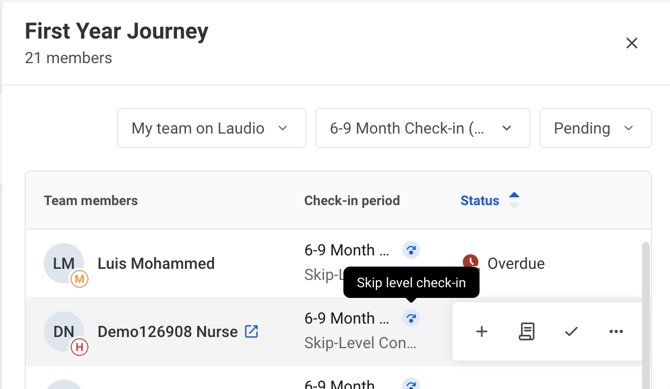
Hover over a milestone row to view the actions available for that interval. Available actions vary based on the type of touchpoint and who is responsible for the milestone.
Examples include:
- Send Message
- Add Note
- Send InForm (when applicable)
For Skip-Level intervals, only the actions that are relevant to the senior leader are displayed. This creates a focused experience and helps ensure leaders see only the actions needed for that milestone.
FAQs
Q: Who can complete a Skip-Level Check-in?
A: Skip-Level Check-ins are limited to leader-of-leader conversations. When an interval is configured as a Skip-Level Check-in, only the direct manager's manager receives the action.
Q: Can the direct manager view a Skip-Level Check-in?
A: The direct manager does not receive or complete the check-in, but can view progress within the journey map and see related activity.
Q: What actions are available during a Skip-Level Check-in?
A: Available actions depend on the interval configuration. Examples include Send Message, Add Note, and Send InForm. Skip-Level intervals display only the actions relevant to the senior leader.
Q: Are all First-Year Journey milestones Skip-Level Check-ins?
A: No. Individual intervals can be configured as standard check-ins or Skip-Level Check-ins, depending on the desired experience.
Q: Can Skip-Level Check-ins be configured for anyone outside the leader-of-leader relationship?
A: No. Skip-Level Check-ins are currently limited to direct manager's manager interactions.
Related Links
- New Hire Check-ins
- First-Year Journey Overview
- Using InForms
- Managing Tasks in Laudio
- Employee Recognition Overview